
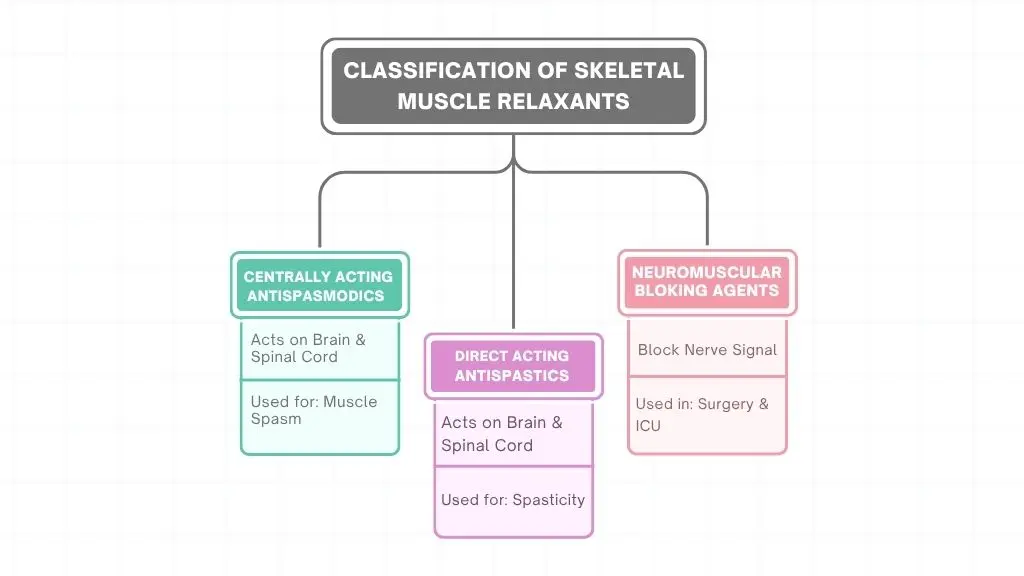
Skeletal muscle relaxants are a group of medications used to reduce muscle spasms, stiffness, and involuntary muscle contractions. These drugs are commonly prescribed in conditions such as acute back pain, muscle injuries, and neurological disorders.
Understanding the classification of skeletal muscle relaxants is important because each category works differently and is used for specific medical conditions. This classification is based on how these drugs act in the body and their clinical applications.
📌 Quick Answer

Skeletal muscle relaxants are classified into three main types: centrally acting muscle relaxants, direct-acting muscle relaxants, and neuromuscular blocking agents. These drugs are used to treat muscle spasms, spasticity, and to produce muscle relaxation during surgery.
What Are Skeletal Muscle Relaxants?
Skeletal muscle relaxants are medications that help relieve muscle spasms and reduce muscle tone. Most of these drugs act on the central nervous system, while some work directly on muscles or at the neuromuscular junction.
They are commonly used for:
- Muscle spasms
- Muscle stiffness
- Musculoskeletal pain
- Neurological conditions causing spasticity
Classification of Skeletal Muscle Relaxants
Skeletal muscle relaxants are broadly classified into three main categories:
1. Centrally Acting Muscle Relaxants (Antispasmodics)
Centrally acting muscle relaxants are predominantly antispasmodics that work on the brain and spinal cord to reduce muscle spasms and stiffness. These drugs do not act directly on muscle fibers but instead suppress nerve signals that cause muscle contraction.
This classification of drugs is most commonly used to relieve muscle spasms and stiffness, especially in conditions like back pain and muscle injury.
They are most commonly used for short-term relief of acute muscle spasms.
Uses:
- Acute back pain
- Muscle strain
- Neck pain
- Muscle spasms due to injury
These drugs are widely prescribed because they provide quick relief from painful muscle contractions.
2. Direct Acting Muscle Relaxants (Antispastics)
Direct acting muscle relaxants act directly on skeletal muscles or spinal pathways. These medications are mainly used to treat muscle spasticity caused by neurological disorders.
Unlike centrally acting drugs, they target the muscle or spinal cord more directly.
Uses:
- Multiple sclerosis
- Spinal cord injury
- Cerebral palsy
These drugs are useful for long-term management of muscle stiffness rather than sudden spasms.
3. Neuromuscular Blocking Agents
Neuromuscular blocking agents act at the neuromuscular junction, where nerves communicate with muscles. These drugs block the transmission of nerve impulses, leading to complete muscle relaxation.
They are not used for routine muscle pain but are essential in medical procedures.
Uses:
- Surgical procedures
- Anesthesia
- Mechanical ventilation support
These drugs are typically administered in hospital settings under strict medical supervision.
Classification Table of Skeletal Muscle Relaxants
The table below summarizes the classification of skeletal muscle relaxants based on their mechanism of action and clinical use.
| Class | Examples | Mechanism of Action | Main Use |
|---|---|---|---|
| Centrally Acting | Cyclobenzaprine, Carisoprodol, Tizanidine, Baclofen | Act on CNS (brain & spinal cord) | Muscle spasms |
| Direct Acting | Dantrolene | Acts directly on skeletal muscle fibers | Spasticity |
| Neuromuscular Blocking | Succinylcholine, Vecuronium | Block nerve-muscle transmission | Surgery |
This table provides a quick and clear overview of the classification, making it useful for both students and healthcare readers.
Key Differences Between the Classes
- Centrally acting drugs are mainly used for short-term muscle spasms.
- Direct acting drugs are used for chronic conditions involving muscle stiffness.
- Neuromuscular blocking agents are used in surgical and critical care settings.
Each class has a different mechanism, which determines its clinical use.
Mechanism-Based Understanding
The classification of skeletal muscle relaxants is primarily based on how they affect muscle activity:
- Some drugs reduce nerve signals from the brain and spinal cord
- Some act directly on muscle fibers
- Others block communication between nerves and muscles
This mechanism-based classification helps doctors choose the most appropriate treatment for different conditions.
Clinical Importance of Classification
Understanding this classification is important for:
- Selecting the right medication
- Avoiding unnecessary side effects
- Managing different types of muscle disorders effectively
For example, a patient with simple muscle strain may need a centrally acting drug, while someone with multiple sclerosis may require a direct acting muscle relaxant.
List of Skeletal Muscle Relaxants
Skeletal muscle relaxant drugs are medicines used to reduce muscle spasms, stiffness, and pain. Common examples include:
Centrally Acting Muscle Relaxants
- Cyclobenzaprine
- Carisoprodol
- Methocarbamol
- Tizanidine
- Diazepam
- Metaxalone
- Chlorzoxazone
- Baclofen
Direct-Acting Muscle Relaxant
- Dantrolene
Neuromuscular Blocking Agents (used in surgery/anesthesia)
- Succinylcholine
- Vecuronium
- Rocuronium
Conclusion
The classification of skeletal muscle relaxants helps in understanding how different drugs work and when they should be used. By dividing these medications into centrally acting, direct acting, and neuromuscular blocking agents, healthcare professionals can choose the most appropriate treatment based on the patient’s condition. Proper use of these medications improves treatment outcomes and reduces the risk of side effects.
FAQs
They are classified into centrally acting muscle relaxants, direct acting muscle relaxants, and neuromuscular blocking agents.
These are drugs that act on the brain and spinal cord to reduce muscle spasms.
They are used to treat muscle spasticity caused by neurological conditions.
These are drugs that block nerve signals to muscles and are mainly used during surgery.
Some are used short-term, while others are prescribed for long-term conditions depending on the cause.